


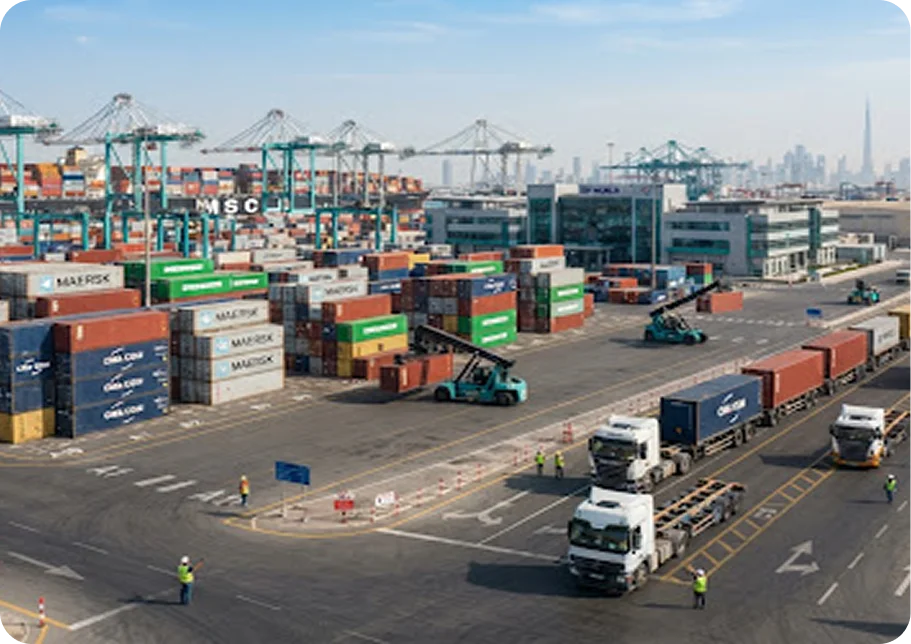


CPL Logistics × LogixPlatform: A case study in rapid implementation and measurable impact
CPL Logistics, the logistics division of Lootah Holding in the UAE, operates from a strategic location at Al Maktoum Airport Street, Dubai—a prime hub connecting air, sea, and land transport networks across the region.
CPL Logistics faced common but critical hurdles that limited efficiency and growth. Their operations were hampered by disconnected systems and manual processes.
Fragmented systems across freight, warehouse, and finance created manual reconciliation burdens and no single source of truth for critical business decisions.
Lack of real-time tracking for shipments, inventory levels, and
performance KPIs hindered
proactive decision-making and
client service quality.
Paper-based warehouse processes and delayed documentation workflows caused bottlenecks in customs clearance, picking, packing, and dispatch operations.
Limited financial integration with
Microsoft 360 resulted in slow
invoicing cycles, billing errors, and
cash flow challenges that
impacted business operations.
An integrated, modular platform designed specifically for complex 3PL operations, combining logistics-specific functionality with enterprise-grade scalability.
Logistics-focused customer relationship management with contract tracking, SLA monitoring, and client-specific workflow management.
Complete freight forwarding suite managing air, sea, and road shipments with AWB, BOL, tracking, and carrier integration capabilities.
Advanced 3PL warehouse management system supporting multi-client inventory, inbound receiving, intelligent picking, and dispatch orchestration.
Comprehensive financial management with automated invoicing, customs duty calculations, and seamless Microsoft 360 synchronisation for accurate reporting.
The LogixGrid team worked alongside CPL’s operations, warehouse, and finance teams to ensure comprehensive business analysis and smooth user adoption through hands-on training sessions.
Business analysis and workflow mapping across all operational areas
Module configuration for FreightNX, WMS, CRM, and Finance systems
Custom workflow creation using NO-CODE engine for client-specific requirements
Rugged mobility device
deployment and warehouse floor integration
Comprehensive user training and successful go-live across all facilities
Order processing time reduced from 7–12 minutes to just 2–4 minutes per transaction
Warehouse productivity increased by 35–50% through optimised workflows and real-time data
Near-perfect accuracy achieved
through rugged device scanning, up from 85–90% baseline
Manual reconciliation effort decreased by 70–80% through automated system synchronisation
Real-time dashboards provide instant access to critical operational data across freight, warehouse, and financial operations—eliminating information silos and enabling proactive management.
Monitor air, sea, and road shipments with real-time status updates, carrier information, and estimated delivery times across all active consignments.
Track inbound receiving, putaway progress, active picking tasks, and dispatch schedules with SKU-level visibility across multi-client inventory.
View invoices generated, customs duties payable, cash flow impacts, and Microsoft 360 synchronisation status for complete financial transparency.
Receive automated notifications for delayed shipments, low stock levels, client SLA breaches, & operational exceptions requiring immediate attention.
The transformation from paper-based processes to mobile-enabled operations revolutionised warehouse productivity, enabling CPL to handle higher volumes with improved accuracy and faster turnaround times.
LogixPlatform’s NO-CODE engine enables CPL to rapidly onboard new clients with unique operational requirements—customising rates, SLAs, routing logic, customs workflows, and reporting formats without writing a single line of code.
This flexibility means CPL can respond to client needs in days rather than months, creating competitive advantage through agility whilst maintaining system stability and reducing dependence on technical resources.
Instant customization of customer rates, invoicing frequencies, and specialized delivery triggers.
Dynamic conditional parameters for cross-border customs declarations and bonded storage rules.
Intuitive visual interfaces allowing operational supervisors to tailor dispatch validations effortlessly.
Enterprise stability guaranteed with isolated version control and immediate rollout capability.
ROI achieved within 60–90 days through operational efficiency gains & accelerated billing cycles
14-day implementation showcasing the power of purpose-built logistics technology
Future-ready architecture supporting business growth and new service offerings
CPL Logistics and LogixGrid have demonstrated that integrated digital transformation—executed with the
right technology partner and shared vision—can revolutionise 3PL operations in record time, delivering
measurable impact across efficiency, visibility, accuracy, and client satisfaction.
Bring all your operations to a single system, streamlining workflows and boosting efficiency.

Business Case Study and Report
Company Overview
Challenges and Objectives
The Process
Proposed Solutions
The Word From Leading multinational 3PL
Metrics
A leading end-to-end logistics solutions provider in India, delivering integrated freight forwarding, warehousing, and supply chain services.
Leading multinational 3PL India is a major Japanese freight forwarding company. The organization provides international air and sea freight forwarding, customs handling, warehousing, and last-mile delivery services.
With a focus on customer service, operational excellence, and a productive work environment, Leading multinational 3PL India serves clients across industries including electronics, automotive, healthcare, and retail.
Its diverse client base requires logistics workflows that can adapt to different operational requirements while maintaining consistent service levels.

As Leading multinational 3PL India expanded its logistics operations, growing client requirements and manual workflows created challenges in efficiency, visibility, and scalability.

Each client had unique storage methods, order processing rules, product handling requirements, and reporting formats. Existing workflows were difficult to adapt without extensive manual intervention.
Difficulty scaling operations, adjusting to new client requirements, and maintaining consistent service levels.

Manual inventory updates, order picking, and shipment scheduling consumed time. Outdated scanning devices also resulted in inaccurate data, double-checking, and rework.
Processing backlogs, extended working hours, increased operating costs, and reduced staff productivity.

Inventory status, shipment tracking, and warehouse performance data were not consistently updated in real time. Information was spread across disconnected systems.
Incomplete operational information, longer decision-making cycles, and difficulty providing timely client updates.

Carrier label generation, printing, organizing, and shipment tracking were handled manually across multiple carrier systems.
Increased risk of label errors, repetitive work, inconsistent delivery
performance, and limited scalability.
The transformation focused on creating a scalable platform that could support client-specific workflows while improving operational efficiency and visibility.
Adapt workflows to diverse client requirements without compromising efficiency.
Connect client ERP and OMS systems to create a cohesive supply chain ecosystem.
Automate inventory, fulfillment, dispatch, and label generation processes.
Provide current inventory, shipment, and warehouse performance information.
LogixGRID leveraged the versatility of LogixPlatform to provide Warehouse Management, Logistics Management, and connected operational capabilities within a unified technology ecosystem.
Warehouse Management System designed to improve inventory accuracy, optimize stock locations, and automate fulfillment processes.
Logistics Management System supporting automated dispatch, delivery tracking, routing efficiency, and integration with connected logistics workflows.
The platform’s API gateway enabled connectivity with diverse client systems, including ERP, TMS, and EDI platforms, while scalable infrastructure supported increasing operational demands.
LogixGRID’s WMS was configured to support different product handling requirements, specialized order workflows, service-level agreements, and proprietary client system integrations.
The implementation of LogixGRID’s Warehouse Management System addressed core operational challenges through improved inventory accuracy, automation, mobility, and data-driven decision-making.
Real-time inventory tracking helped maintain accurate stock information across warehouse locations. Automated picking, packaging, and dispatch reduced manual intervention and supported faster order fulfillment.
Barcode scanning and RFID technology provided a stronger foundation for tracking inventory and shipments, while mobile access allowed warehouse workers to update stock information directly from the warehouse floor.
Advanced reporting and analytics provided operational insights into inventory levels, order fulfillment, and shipping performance, supporting more informed decisions.

The implementation combined process mapping, system customization, phased deployment, staff enablement, and technical collaboration.

Leading multinational 3PL and LogixGRID defined objectives, performance metrics, process requirements, and integration needs. Process mapping identified automation opportunities across warehouse and logistics workflows.
The WMS was configured to support Leading multinational 3PL’s diverse client requirements, specialized product handling, inventory tracking, and carrier label management workflows.
The system was deployed in phases across Leading multinational 3PL warehouses to minimize disruption. Staff training and transition support helped employees adopt the new workflows.
Awareness sessions, employee support, and on-ground assistance helped build confidence and encourage adoption of the new system.
Technical issues and integration challenges were addressed through coordinated LogixGRID and Leading multinational 3PL IT efforts, tailored API configurations, testing, and structured training.
The platform brought together operational capabilities designed to improve accuracy, efficiency, flexibility, and visibility.

The WMS implementation improved operational efficiency, resource utilization, client visibility, and the ability to support growing logistics requirements.
Client-specific customization allowed Leading multinational 3PL to adapt its workflows to specialized product handling, order management, and integration requirements. This flexibility supported a more personalized experience for its diverse client base.
The combination of automation, real-time data, and scalable infrastructure helped Leading multinational 3PL address the complexity of multi-client logistics while strengthening operational reliability.
The following outcomes are the quantified results reported in the supplied case- study document.

Reported results from the case-study document demonstrate improvements in fulfillment speed, cost
efficiency, customer satisfaction, scalability, and adoption.
Order processing time reduced from 2 hours to 1.2 hours per order.
98% inventory accuracy
30% increase in picking and packing speed
Automation and RFID integration reduced labor costs and error-related expenses.
Error-related expenses reduced by 50%.
Operational overheads reduced by 15%.
Reported on-time delivery performance improved from 92% to 99%.
Client satisfaction scores increased by 35%.
Real-time updates reported at 100% uptime.
Client onboarding time was reduced, enabling new clients to be onboarded in seven days.
Order capacity increased by 50%.
Capacity of up to 20,000 orders daily.
Employee training reported a 95% success rate within three weeks. System downtime was maintained at less than 0.1%, and custom API configurations reduced setup duration by 50%.
5 new warehouse locations integrated in three months.
| Performance Area | Reported Outcome |
|---|---|
| Order processing time | 40% reduction, from 2 hours to 1.2 hours |
| Inventory accuracy | 98% |
| Picking and packing speed | 30% increase |
| Labor costs | 25% reduction |
| Error-related expenses | 50% reduction |
| Operational overheads | 15% reduction |
| On-time delivery | Improved from 92% to 99% |
| Client satisfaction | 35% improvement |
| Client onboarding | 60% reduction in onboarding time |
| Order capacity | 50% increase, up to 20,000 orders daily |
| Warehouse integration | Five new locations in three months |
| Employee training | 95% success rate within three weeks |
| System downtime | Less than 0.1% |
The case study highlights several factors that supported the implementation and its operational outcomes.

Close collaboration between Leading multinational 3PL, LogixGRID, and its implementation teams aligned the solution with operational goals and client needs.

Structured training, awareness sessions, and on-ground support helped employees transition to improved workflows.

Flexible workflows and integrations helped Leading multinational 3PL accommodate different client requirements and growing order volumes.

WMS capabilities, RFID, mobile access, automation, analytics, and API
integrations supported operational modernization.
The LogixGRID implementation positioned Leading multinational 3PL India to continue expanding its logistics capabilities through technology- driven agility, improved visibility, and client-specific operational support.
The transformation demonstrates how connected warehouse and logistics systems can help address operational complexity while supporting service reliability and scalable growth.
Flexible workflows that can adapt to changing logistics requirements.
Integrated systems that support consistent data exchange and visibility.
Infrastructure designed to support expanding client and order volumes.
Discover how LogixGRID can help your organization connect warehouse operations, logistics workflows, and scalable technology into one platform.