

AI Agents Search Across Systems
Shipment Tracking Without a Tracking Number: How AI Agents Search Across Systems
Losing a string of numbers shouldn’t trigger a missing-persons hunt for a cardboard box. People misplace their codes all the time. When that happens, they still know what day they clicked buy. They know their own zip code, their phone digits, and maybe the truck company hauling the freight. A tracking string is just a temporary nametag, not the actual soul of the moving parcel. Modern supply chains leave a massive digital footprint. Artificial intelligence grabs those scattered clues to hunt down the exact item, even when the main barcode goes missing. When we treat Shipment Tracking as a hunt for context rather than a hunt for a barcode, those invisible dots connect. You no longer need that one magic puzzle piece to solve the mystery.
Why a Tracking Number Is Only One Search Key
A single package carries many secret identities throughout its lifecycle. It starts as a simple cart checkout but quickly gathers new names.
One Shipment, Many Identifiers
Think about how a box travels. A digital cart turns into a warehouse task. That task becomes a truck manifest. The truck hands it off for final drop-off, ending with a signature. Every single step generates a unique code. A simple cart number morphs into a facility code, then an airbill, a dispatcher tag, and finally a driver route number. Losing one single code does not erase the physical box. The record survives. Searching for it requires smarter Shipment Tracking methods that look beyond the obvious.
The Data Exists Somewhere
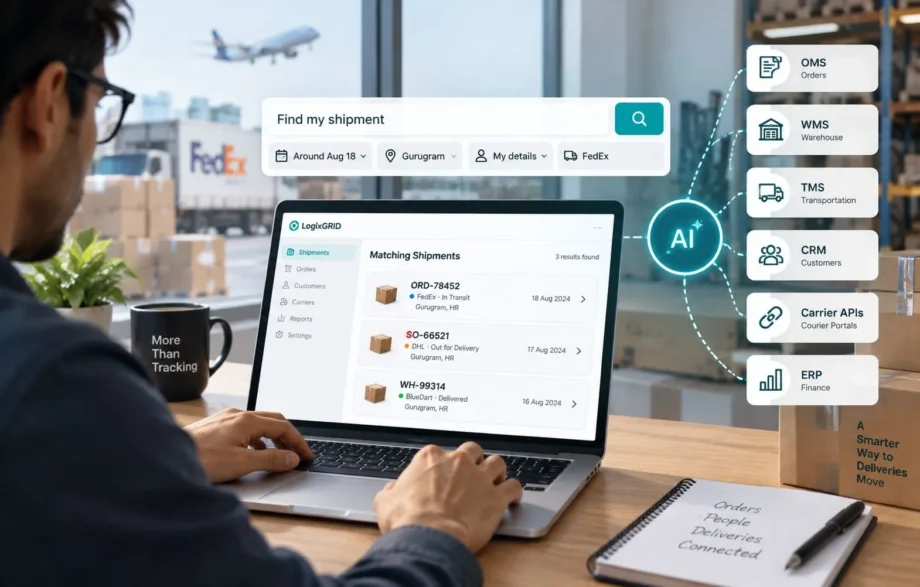
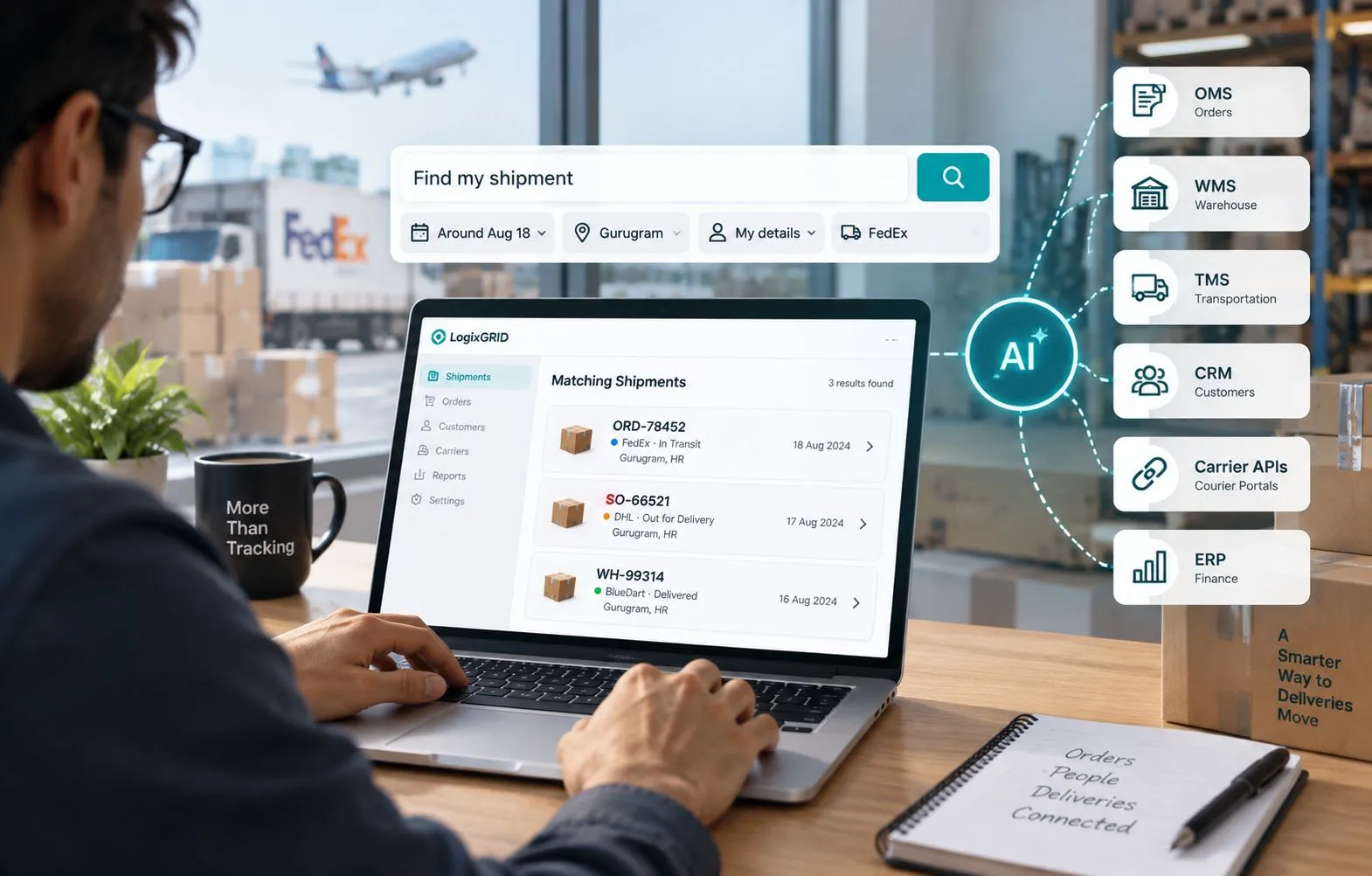
If the primary number is missing, the breadcrumbs live elsewhere. The details sit quietly in an OMS, WMS, TMS, ERP, CRM, or billing system. They hide inside Carrier APIs, courier portals, and delivery applications. Extracting these breadcrumbs is where logistics management software proves its worth, pulling forgotten details out of the dark.
What AI Actually Searches Without the Number
Artificial intelligence is not playing a guessing game with missing freight. Instead, it translates incomplete fragments into highly searchable attributes.
Start With Known Clues
A customer might say, “Find the parcel ordered around August 18, going to Gurugram, which was sent through FedEx.” From that plain sentence, the machine extracts the date, the destination, the customer name, the carrier, the order context, and the physical characteristics.
Search Across Systems
The process follows a logical sequence. It starts with the Customer’s Clues, flows into Natural-Language Understanding, and moves to Candidate Generation. From there, it scans the OMS, WMS, TMS, and Carrier APIs. It performs Event and Attribute Matching, runs Confidence Scoring, picks the Most Likely Shipment, and finally delivers the Current Status and Next Action. This systematic approach redefines modern Shipment Tracking.
Rank, Don’t Guess
The machine ranks candidates rather than handing over the first random match. An exact order reference carries very high weight. An exact destination or customer contact is high. A specific carrier is medium-high, while a date or time window sits at medium. SKU details hold a medium rank, an approximate address is lower, and free-text descriptions act as supporting clues. These illustrative weights guide a shipping management platform toward the absolute right answer, even when the clues are vague.
The Hidden Layer: Shipment Identity Resolution
Finding a lost box gets complicated behind the scenes. Finding a database record is entirely different from resolving an identity.
Matching Is Not Searching
Traditional search looks for a record containing exact text. AI-assisted resolution determines which record most likely represents the physical box described by several incomplete clues. The engine handles fuzzy matching, name aliases, and strange spelling variations. It untangles partial addresses and duplicate customers. It figures out what to do when multiple orders travel to the exact same destination. It makes sense of split shipments, weird returns, and unexpected reshipments.
The Confidence Problem
Because the clues are often messy, the intelligence needs a confidence score to avoid making mistakes. Scores hitting 90 percent or better trigger an automatic green light. Anything hovering in the 70 to 89 percent range makes the system pause and ask the user for one more tiny clue. Below 70 percent, it requests another identifier entirely. These illustrative thresholds keep the operation honest. Good delivery management software relies on this scoring logic to keep bad data from causing worse decisions.
When Multiple Shipments Look the Same
Ambiguity creates a massive headache for any database. Suppose three buyers have the same surname. Two have packages going to the exact same city. The two packages left the dock on the same afternoon. The intelligence cannot safely depend on a single field to tell them apart.
Cross-Checking the Evidence
To solve the riddle, the system cross-checks temporal proximity and normalized addresses. It compares phone and email records, order value, SKU composition, and package count. It studies the carrier, the warehouse origin, and the entire scan history.
The Last-Mile Signal
The latest operational event can sometimes provide stronger identification context than the original purchase order. A box is Ordered Created, Packed, Manifested, Carrier Pickup, Hub Scan, Out for Delivery, and POD. A package accumulates contextual evidence as it moves. By reading this trail, logistics management software pieces together exactly which twin box belongs to which waiting customer.
How AI Searches Across Carrier Systems
Businesses rarely rely on a single delivery partner. They use multiple carriers, each with its own weird terminology, hidden systems, and unique event structures.
One Query, Multiple Sources
A simple Customer Query enters the AI Search Layer. The request splits and queries Carrier A, Carrier B, Carrier C, and the WMS all at once. The machine pulls back messy data, turns it into Normalized Shipment Events, and builds a Unified Shipment Record. This makes intelligent Shipment Tracking a reality across completely disconnected databases.
Why APIs Matter
Background data pipelines handle the messy translation work here. They exchange creation data, partner responses, tracking events, delivery updates, exceptions, and status changes in real time. Without this constant digital chatter, the whole search process falls apart. This is precisely where LogiXGRID’s integration capabilities shine. By acting as the central nervous system, a connected shipping management platform translates all those foreign carrier languages into one readable story.
From Search to Action: What the Agent Does Next
Finding the lost item is not the finish line. The real magic happens right after the system identifies the target.
Finding Is Only Step One
Once located, the automated agent retrieves the latest event and identifies the exact carrier holding the goods. It detects any hidden delay or identifies a bizarre exception. From there, it immediately notifies the waiting customer. It can create a support ticket, trigger a completely new re-delivery workflow, or escalate a failed drop-off to a human supervisor. This is the difference between passive observation and active delivery management software.
The workflow transitions smoothly from Search to Identify, then to Understand, Decide, and finally Act.
Cycle Workflow
Inspect → Clean → Position → Adjust → Reinforce → Pour → Cure → Strip → Inspect → Shift → Repeat
This flips the script entirely. Modern Shipment Tracking becomes a tool for taking direct action rather than just a dusty window to look through.
Where the Data Comes Together
A massive problem arises when different delivery partners describe the exact same physical action using completely different words. Data normalization fixes this mess.
One Operational View
Carrier A might say “In Transit,” Carrier B logs “Moving,” and Carrier C reports “Shipment Moving.” Later, Carrier A logs “Hub Scan,” Carrier B types “At Facility,” and Carrier C notes “Arrived.” Some screens flash “Out for Delivery” while others say “With Driver” or “Delivery Run.” The machine grabs all that messy slang and forces it into neat buckets like IN_TRANSIT, AT_HUB, OUT_FOR_DELIVERY, and DELIVERED. Plugging systems together solves nothing if they speak completely different dialects. The data must become interpretable together, which is the hallmark of a smart shipping management platform.
From Raw Events to Meaning
Normalization turns thousands of carrier-specific jargon phrases into a tiny, clean set of operational states. An AI agent can finally reason over these clean states to make decisions. Without this translation layer, even the best logistics management software would just choke on a pile of confusing words.
The Role of Delivery Data
Last-mile intelligence provides the strongest clues of all. The final stretch generates a wealth of highly specific signals. The system logs driver assignments, route information, GPS events, and actual delivery attempts. It captures the OTP, the POD, the digital signature, the exact timestamp, and the specific failed-delivery reason.
When the Package Has Reached the Last Mile
A buyer might call and simply say, “The driver called me yesterday.” That sounds terribly vague to a human representative. However, that detail becomes incredibly meaningful when correlated with phone records and GPS logs. The more events a parcel accumulates, the more contextual signals an intelligent system can potentially use to identify it. This deep integration is what makes modern delivery management software so incredibly powerful.
Where LogiXGRID Fits
Operations break down when tools refuse to talk to each other. LogiXGRID acts as the connected infrastructure layer that brings shipping, warehouse, delivery, fleet, freight, and workflow operations perfectly together under one unified roof.
One Logistics Ecosystem
You get a massive toolkit containing Logix WMS, LMS, NEO, FMS, FreightNX, Finance, the main Shipping API, DMS, CMS, and LogixFlow. It does not act like a simple desktop app. It works more like a digital brain running your entire supply chain, warehouses, and carrier networks from the cloud. The math proves the point. We are talking about 2.5 million parcels passing through every month. Over 300 companies and 6,000 global users lean on it across 20 nations.
Where Money Goes
Initial fabrication → logistics → installation → repeated cycles → maintenance → refurbishment → residual value
Once you plug all those operational gears together, Shipment Tracking happens completely by accident. It is just what you get when you can see everything at once.
Beyond Tracking
The broader value comes from connecting the moving box to the surrounding operational ecosystem. The data flows naturally from Warehouse to Shipping, then to the Carrier, Delivery, Fleet, Finance, Analytics, and finally Automation. That kind of deep connection turns basic logistics management software into an aggressive problem solver.
What Happens When the AI Can’t Find a Match?
A smart machine knows exactly when to throw its hands up and admit defeat.
No Match
When the machine finds absolutely nothing, it will simply ask the customer for another clue.
Multiple Matches
If it finds twins, it asks a targeted clarification, like, “Was the item sent to Delhi or Gurugram?”
Conflicting Data
The agent will flag the inconsistency rather than inventing a hallucinated answer.
Stale Data
The system differentiates between having no record found versus a record found but no recent event. It knows the difference between an unavailable carrier API and a simple synchronization delay. The critical distinction is that no update does not necessarily mean no shipment. Honest Shipment Tracking requires absolute truth, even when the truth is complicated.
What Businesses Gain From This Approach
Moving from raw mechanics to actual business value changes the conversation completely.
Fewer Support Searches
Customer service teams no longer need to manually jump between ten different carrier portals to find answers.
Better Exception Handling
Missing information becomes a highly solvable data problem rather than an absolute dead end.
Faster Resolution
The system begins resolving the stressful issue with whatever tiny scrap of information the buyer actually holds in their hand.
Better Data Continuity
The digital record remains completely connected from the initial order creation straight through to the final physical drop-off.
Reuse Economics
INITIAL INVESTMENT
↓
FORM SYSTEM
↓
CYCLE 01
↓
CYCLE 02
↓
…
↓
CYCLE 300
↓
LOWER COST / CYCLE
This functions alongside the core operational flow:
Fragmented Data → Connected Systems → AI Correlation → Shipment Identity → Live Operational Context → Automated Action
By seamlessly connecting these operational steps, modern delivery management software saves companies countless hours of frustrating detective work every week.
The Future Is Tracking by Context, Not Just Numbers
The industry is rapidly shifting from rigid identifier-based systems to fluid, context-aware logistics.
Instead of commanding a user to “Enter your tracking number,” the future interaction feels entirely different. A manager could simply say, “Find the order sent last Tuesday to our Bengaluru warehouse.” The machine instantly converts these natural language clues into highly structured search conditions.
The bigger argument here is profound. Logistics platforms are moving away from merely storing random identifiers. They are learning to understand the deep relationships between orders, boxes, carriers, warehouses, customers, and final drop-off events. This is the new frontier of Shipment Tracking.
In Conclusion
A random string of digits is only one small piece of the puzzle. The true information exists scattered across multiple interconnected systems. Intelligent agents can correlate those partial clues seamlessly. Entity resolution proves far more important than a simple database search, while confidence scoring prevents wildly incorrect matches. Also, APIs and normalized events make cross-carrier searches a working reality. The ultimate goal is never about finding a lost number. It is about locating the right box and understanding its live operational state. LogiXGRID builds the connected, automated operations needed to make this level of intelligence possible.
Acronyms Used
| Acronym | Full Form |
|---|---|
| AI | Artificial Intelligence |
| API | Application Programming Interface |
| OMS | Order Management System |
| WMS | Warehouse Management System |
| TMS | Transportation Management System |
| ERP | Enterprise Resource Planning |
| CRM | Customer Relationship Management |
| DMS | Delivery Management System |
| LMS | Logistics Management System |
| FMS | Fleet Management System |
| POD | Proof of Delivery |
| SKU | Stock Keeping Unit |
| GPS | Global Positioning System |
| OTP | One-Time Password |
| AWB | Air Waybill |
FAQs
1. What should you look for in a shipping management platform?
Look for reliable carrier integrations, multi-carrier visibility, API connectivity, automated workflows, real-time updates, and support for multiple locations and shipping operations.
2. Can logistics management software track shipments across multiple carriers?
Yes. Modern systems can connect multiple carrier APIs, normalize their status data, and present shipment events through a single operational view.
3. How does delivery management software help when tracking information is missing?
It can correlate alternative details such as order IDs, customer information, addresses, delivery events, carrier data, and timestamps to identify the most likely shipment.
4. Is a shipping management platform useful for businesses with multiple warehouses?
Yes. It can centralize orders, carrier operations, shipment data, and warehouse activity, reducing the need to switch between separate systems as operations scale.
5. What is the difference between shipping management and logistics management software?
Shipping management focuses mainly on carrier selection, shipment execution, labels, rates, and tracking. Logistics management software connects these functions with broader warehouse, transportation, delivery, and operational workflows.