

What Is WISMO?
WISMO stands for “Where Is My Order” — the single most common customer support query across e-commerce and direct-to-consumer businesses. A WISMO ticket is raised every time a customer doesn’t know where their order is and can’t find out without contacting your support team.
To reduce WISMO tickets is to solve one of the highest-volume, most repetitive problems in e-commerce customer service. Most WISMO queries have the same answer: the carrier has the package, it’s in transit, and it will arrive on a predicted date. No human insight is required. What’s required is access to real-time tracking data and the ability to communicate it to the customer in the right format at the right time. That’s exactly what AI agents for e-commerce are built to do. LogixFlow by LogixGrid is an AI-based logistics automation platform with out-of-the-box agents specifically designed for order status inquiries — reducing inbound support volume before it becomes a ticket. This guide covers why WISMO happens, what it costs, and how AI agents eliminate it systematically.
Why Do Customers Raise WISMO Tickets?
WISMO queries have three root causes:
No proactive communication. The customer placed the order, received a confirmation, and then heard nothing until they decided to enquire. No shipping confirmation, no tracking link, no ETA update. The information gap creates the query.
Tracking links that don’t work or don’t update. A tracking number that returns “no information available” or hasn’t updated in 48 hours doesn’t reassure the customer — it escalates concern into a support ticket.
ETA changes with no notification. A delivery that was predicted for Thursday arrives Saturday with no explanation in between. The customer calls because the only update they have is wrong.
All three are information delivery problems, not fulfilment problems. The order may be moving perfectly through the supply chain. The customer just doesn’t know that.
How Does WISMO Affect Your Business?
The business cost of WISMO is measurable across three dimensions.
Support volume. Studies across e-commerce operations consistently find WISMO queries represent 35–50% of total support ticket volume. A team sized for general support is spending half its capacity answering questions that a real-time tracking system should answer automatically.
Cost per ticket. The average cost of handling a human-assisted support ticket — agent time, tooling, management overhead — runs ₹200–₹600 in most Indian e-commerce operations. At high order volumes, the aggregate WISMO cost becomes a significant line item.
Customer experience. A customer who has to contact support to find out where their order is has already had a worse experience than one who received a proactive update. The support interaction — even if resolved quickly — doesn’t recover the experience fully. Customer satisfaction scores consistently drop when WISMO volume is high.
Agent morale. Support agents fielding identical repetitive queries for hours reduce effectiveness and increase attrition. The problem costs more than the ticket volume suggests.
Manual vs Automated Order Tracking
The manual process: customer raises a ticket, agent opens the order management system, checks the carrier portal, retrieves the tracking status, and replies. Three to five minutes per ticket, multiplied by hundreds of tickets per day.
Automated order tracking changes the equation at both ends. Outbound: the system sends proactive shipping confirmations, tracking links, and delay notifications without human intervention. Inbound: when a customer does enquire, the automated system retrieves and responds to the status query without an agent touching it.
The manual approach is correct for complex queries — damage claims, wrong items, returns. It is categorically the wrong approach for status queries that have a single factual answer.
How AI Agents Can Reduce WISMO Tickets
An AI agent for order status inquiries does more than retrieve tracking data. It interprets that data in the context of the customer’s expectation and communicates it usefully.
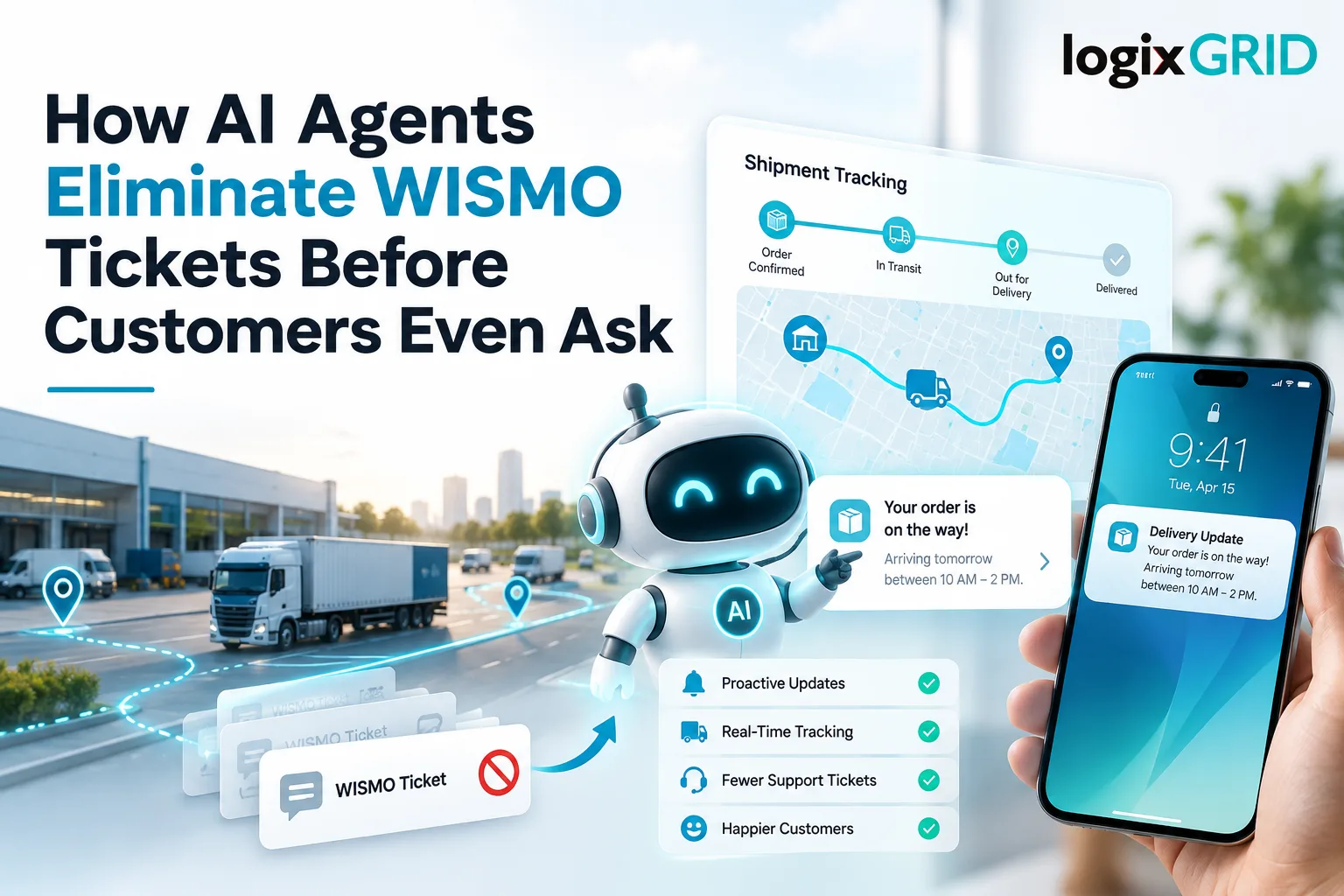
Proactive outbound notifications. The agent monitors the order lifecycle and triggers relevant updates: order confirmed, shipped, out for delivery, delivered. It also triggers exception notifications — delay detected, delivery attempted, held at facility — before the customer notices and before they raise a ticket.
Inbound query resolution. When a customer contacts support with a WISMO query — through chat, email, or WhatsApp — the AI agent reads the order ID or email address, retrieves the current carrier status, and responds with the current location, the estimated delivery date, and any relevant exception notes. This happens in seconds without a human agent.
Intelligent escalation. If the query falls outside the AI agent’s resolution scope — a genuine delivery failure, a damaged item claim, a complaint — the agent escalates to a human with the relevant order context already assembled. The human agent receives a complete handover, not a blank ticket.
LogixFlow’s AI agents include purpose-built order status query handling with carrier API integration and natural language response generation — deployable across WhatsApp, email, and chat surfaces without custom development.
AI Agents vs AI Chatbots for Order Tracking
The distinction matters practically. An AI chatbot is a rules-based or LLM-powered conversational interface. It can retrieve a tracking status when a customer asks for it. But it waits for the customer to ask.
An AI agent is autonomous. It doesn’t wait for the customer to raise a query — it monitors the order status, identifies the right moment to communicate, and acts. It can also take actions: triggering a carrier re-delivery request, updating an estimated delivery in the order management system, or escalating an exception ticket to a logistics operations team.
The difference between AI customer support at the chatbot level and at the agent level is the difference between reactive and proactive WISMO management. Chatbots reduce the cost of answering WISMO queries. Agents reduce the number of WISMO queries that arise.
Read more: Warehouse Management System Cost Guide: Pricing & Factors
How to Prevent WISMO Before Customers Ask
Prevention is more effective than resolution. The tactics that genuinely reduce WISMO tickets at the source:
Send a shipping confirmation within 30 minutes of despatch. Include the tracking number, the carrier name, and a functional tracking link. This single intervention eliminates a significant share of first-day WISMO queries.
Set realistic ETAs and communicate changes. An ETA that’s off by two days is tolerable when the customer knows about it in advance. It becomes a support ticket when they discover it themselves on the expected delivery day.
Notify on every status change, not just despatch and delivery. Out-for-delivery notifications reduce same-day WISMO queries significantly — customers know the package is coming that day without having to check.
Make tracking self-service and accurate. If the tracking link in the confirmation email doesn’t work, the customer’s next step is a support ticket. Carrier integration quality determines whether the self-service option actually self-services.
Flag delays before customers notice. If the carrier data shows a delay versus the predicted ETA, send an exception update proactively. “Your order has been delayed — here’s the updated delivery date” is a better experience than silence followed by a missed delivery.
Benefits of Using AI Agents for WISMO
Support ticket volume reduction. Businesses that deploy proactive order communication and AI-assisted inbound resolution typically see WISMO ticket volume drop 40–65% within the first 60 days.
Faster resolution time. AI-handled queries resolve in seconds versus the minutes required for human-assisted handling. Customer satisfaction at resolution is consistently higher when the response is immediate.
Scalable without headcount growth. Order volume can double without proportional support headcount growth when WISMO queries are automated. The AI agent handles the volume increase without hiring.
Better data on exception patterns. AI agents that handle WISMO queries at scale surface patterns — which carriers generate the most delay-related queries, which product categories have the highest exception rates — that inform operational decisions.
Human agents focused on complexity. Customer service automation of routine status queries frees human agents for the queries that actually require human judgement: complaints, returns, exceptions, escalations.
Conclusion
To reduce WISMO tickets systematically requires both proactive communication and automated inbound resolution. The technology to do this at scale — AI agents that monitor order status, trigger relevant updates, and resolve incoming queries without human intervention — is available and deployable without custom development.
LogixFlow by LogixGrid provides purpose-built AI agents for logistics operations, including order status query handling with carrier integration, proactive notification workflows, and seamless escalation to human teams. Book a demo at logixgrid.com to see how WISMO automation works in practice.
FAQs
What does WISMO mean in e-commerce?
WISMO means “Where Is My Order” and refers to customer queries about shipment status, location, or expected delivery.
How do AI agents reduce WISMO tickets?
AI agents monitor orders, send proactive updates, resolve status queries automatically, and escalate genuine delivery issues to human agents.
Can AI handle “Where Is My Order” queries?
Yes, AI agents can retrieve real-time tracking information and provide customers with order status, location, and estimated delivery dates.
How can businesses prevent “Where Is My Order” calls?
Businesses can send proactive tracking updates, communicate ETA changes, provide accurate tracking links, and notify customers about delays.
What is the difference between an AI chatbot and an AI agent?
An AI chatbot responds when customers ask, while an AI agent can proactively monitor orders, trigger updates, and take authorised actions.