

Automotive manufacturing runs on precision. A single vehicle is assembled from thousands of parts sourced from hundreds of suppliers, and every one of them has to arrive at a specific gate, on a specific day, in a specific sequence. There is no buffer to hide behind — modern OEMs deliberately run lean, which means the inventory that used to absorb supply shocks simply isn't there anymore.
The consequence is brutal arithmetic. Industry estimates put the cost of unplanned downtime at an average automotive plant at roughly USD 22,000 per minute, with high-volume lines running closer to USD 50,000 per minute — about USD 3 million an hour. A single truck stuck outside a plant gate for 45 minutes can erase more than half a million dollars of output.
And yet, in a startling number of OEM supply chains, the answer to "where is that consignment right now?" is still a phone call to a transporter, followed by a WhatsApp message to a driver.
That gap — between a meticulously planned schedule and a completely unobserved execution — is what an automotive logistics management system is built to close.
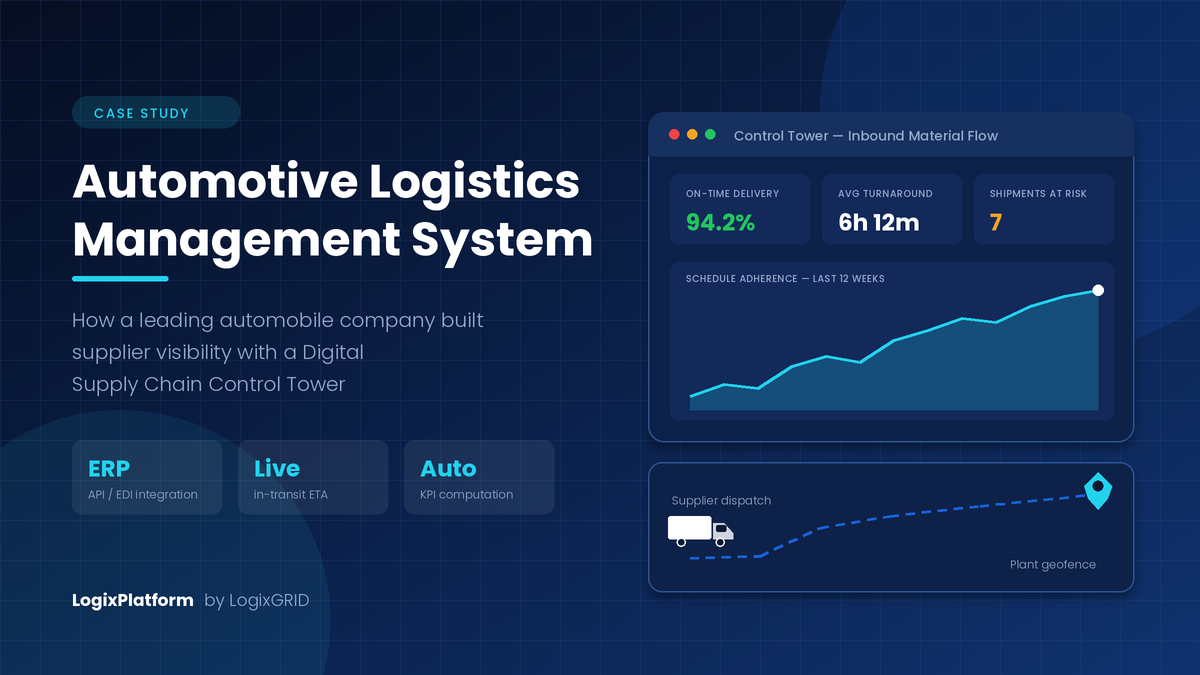
This post walks through exactly how a leading automobile company closed it, using a Digital Supply Chain Control Tower built on LogixPlatform.
The automotive logistics opportunity, in numbers
Before the case study, the market context — because this is not a niche problem.
All financial figures in this article are stated in US dollars.
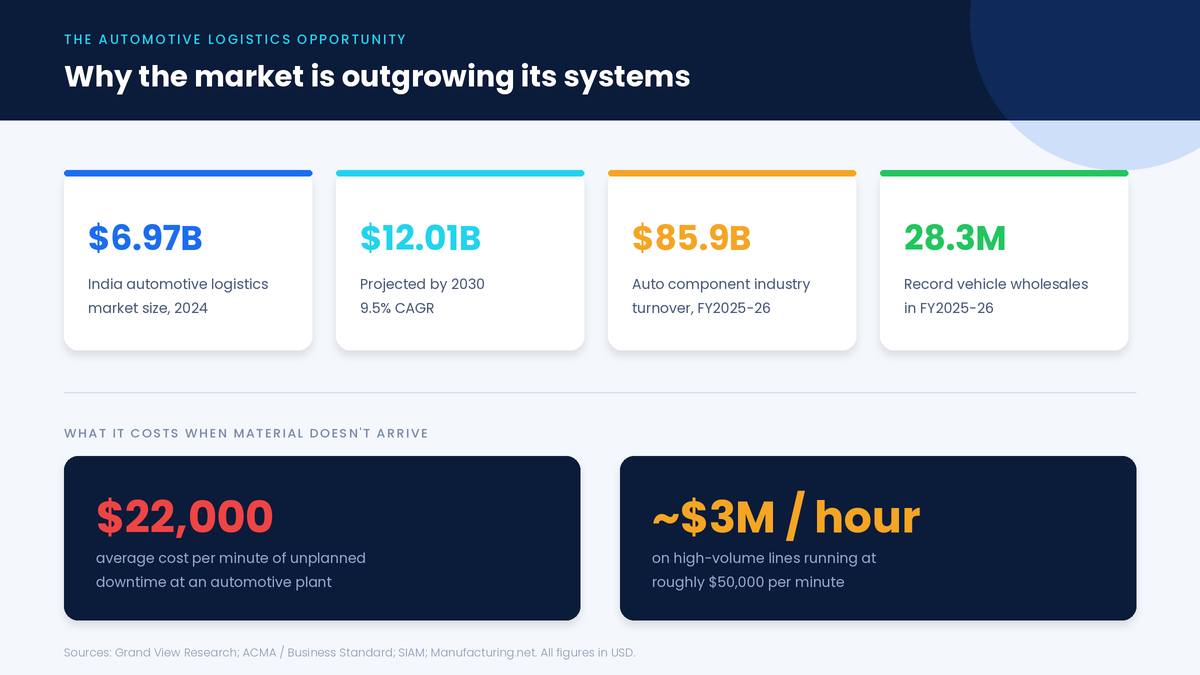
Supplies to OEMs alone grew 16.3% to USD 75 billion in FY2025–26. Every dollar of that is a physical movement someone has to plan, dispatch, track and receive. Read those numbers together and the picture is clear: more volume, more variants, more inbound complexity — against planning systems that largely stop at the ERP boundary.
Why automotive is a large opportunity for 3PLs
For third-party logistics providers, automotive is one of the most attractive verticals available — and one of the hardest to win on price alone.
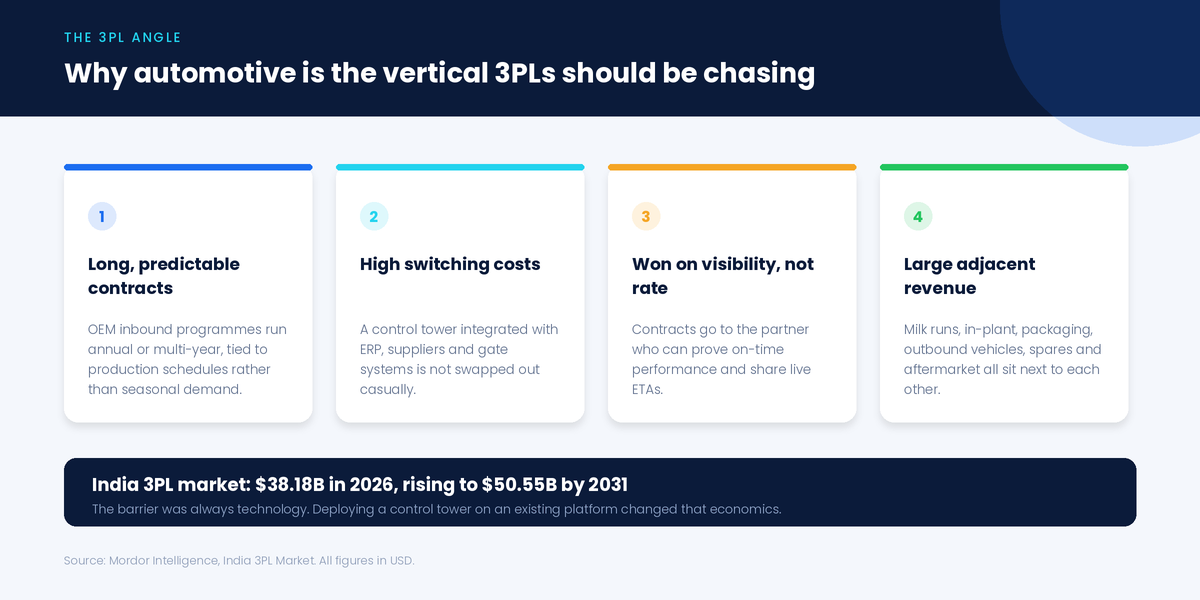
Contracts are long and volumes are predictable
OEM inbound programmes are annual or multi-year, tied to production schedules rather than seasonal demand. That's revenue a 3PL can actually plan around.
Switching costs are high — in your favour, once you're in
An automotive logistics management system integrated with an OEM's ERP, its supplier network and its gate systems is not swapped out casually.
The buying criterion is visibility, not rate
OEMs do not award milk-run or line-feed contracts to whoever quotes two dollars less per trip. They award them to the partner who can prove on-time performance, share live ETAs and produce clean KPI data at the monthly review. A 3PL that shows up with a control tower dashboard is competing on a different axis entirely.
Adjacent revenue is substantial
Inbound milk runs, in-plant logistics, packaging and returnable bin management, finished-vehicle outbound, spare-parts distribution and aftermarket fulfilment all sit next to each other. Win visibility on one, and you're the incumbent for the rest.
The problem statement: key challenges faced by the automobile OEM
This was not a disorganised operation. Quite the opposite — production schedules were planned well in advance and shared with suppliers through a structured process. The breakdown was not in planning. It was in observing execution.
Once a schedule left the ERP, it disappeared into a blind spot until material physically showed up at the gate. Specifically:
- Limited visibility into supplier dispatch status. Had the supplier dispatched? Partially? Not at all? The answer arrived by email, if at all.
- No real-time tracking of materials once dispatched. Between the supplier's dock and the plant gate, the consignment was effectively unobserved.
- Dependency on manual communication. Coordination ran on phone calls, emails and WhatsApp between OEM planners, suppliers and transporters.
- Delays discovered too late. Problems surfaced when the line was already at risk, not while there was still time to expedite, re-sequence or re-plan.
- No structured KPI tracking. Supplier and transporter performance was assessed from memory and anecdote, not data. Review meetings became negotiations about whose version of events was correct.
- Manufacturing lines planned against assumptions. Schedulers planned against what should be arriving, not what was arriving.
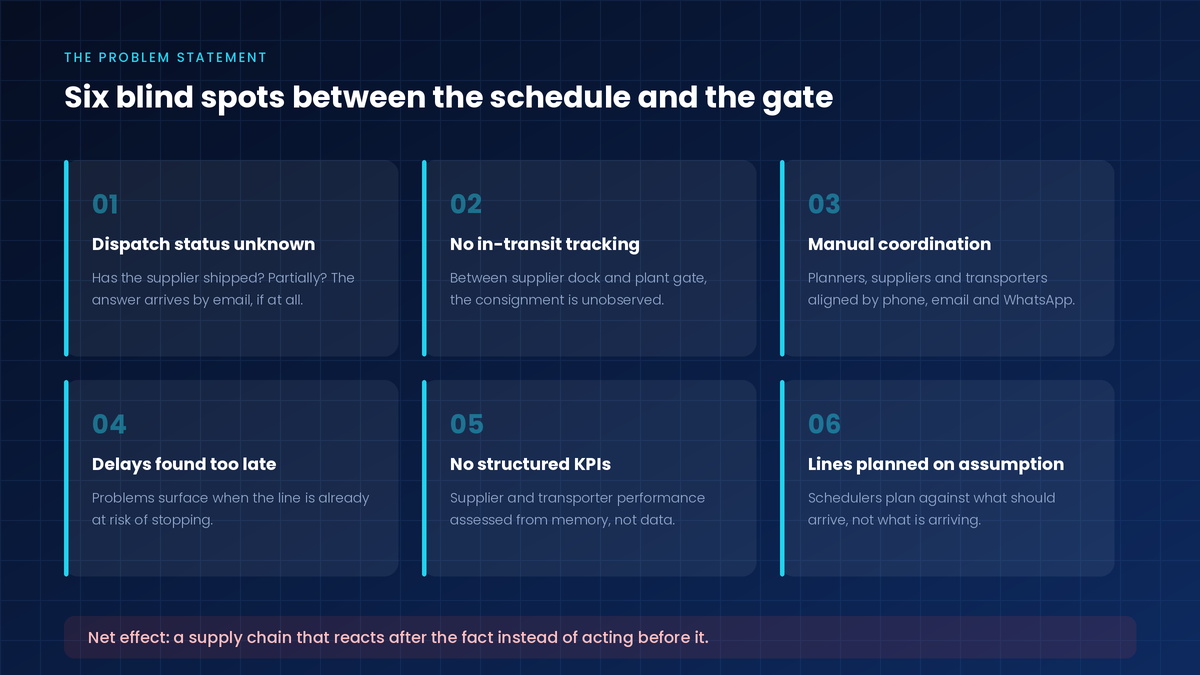
The net effect: a supply chain that was reactive rather than proactive. Every intervention happened after the fact.
The approach: building a connected supply chain
The fix was not another tracking app bolted onto the side. It was a Digital Supply Chain Control Tower implemented on LogixPlatform, with one design principle behind it:
Bring every stakeholder — OEM teams, suppliers and logistics service providers — onto a single connected platform, so that scheduling, dispatch and transportation stop being three separate systems that occasionally email each other.
Instead of three silos loosely stitched together by human effort, all activity was aligned through one system of record.
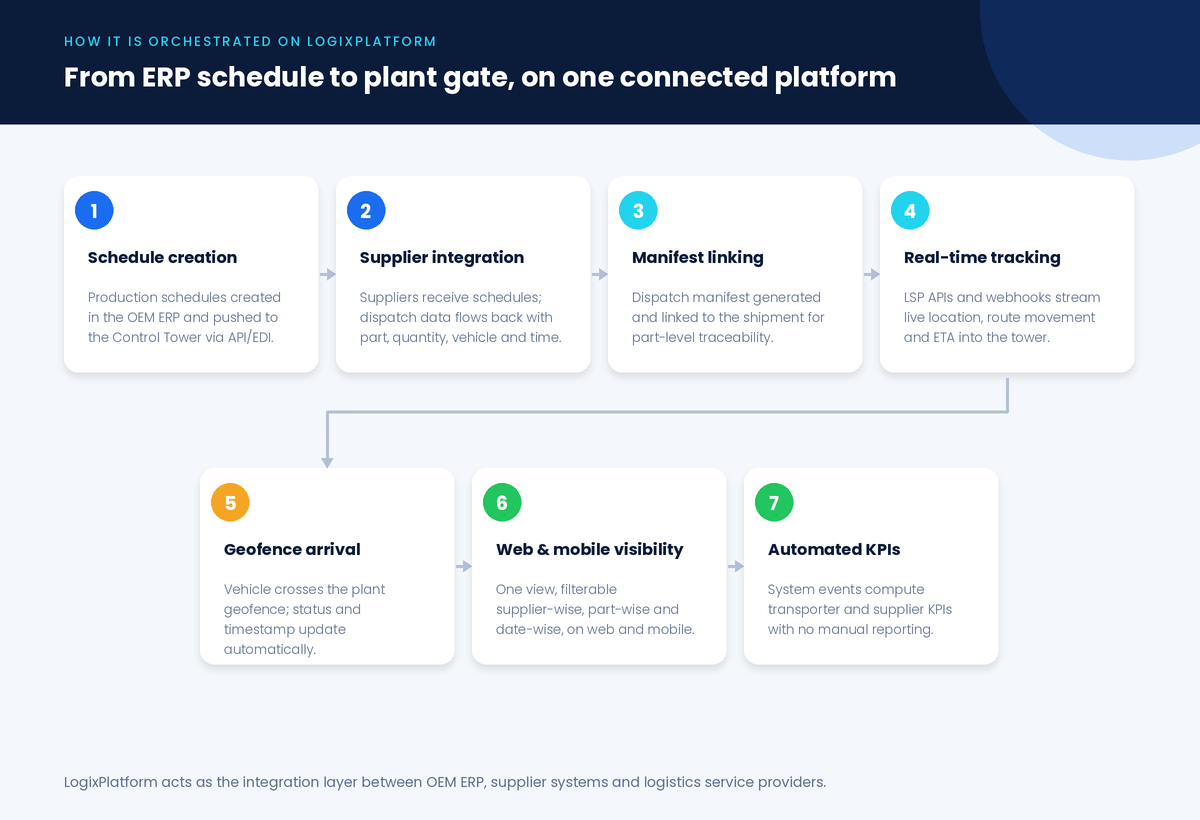
How the business process is orchestrated on LogixPlatform
-
Schedule creation and ERP integration
Production schedules originate where they should — in the OEM's ERP — and are transmitted automatically to the Control Tower via API/EDI integration.
- LogixPlatform acts as the integration layer between the OEM's ERP and all external systems
- Schedule data (supplier, part number, quantity, timeline) is fetched in real time
- The same schedule is pushed onward to supplier systems through API/EDI connectors
No re-keying. No spreadsheet attached to an email. System-to-system communication, end to end.
-
Supplier integration and dispatch updates
Suppliers receive schedules directly in their own systems, or through the supplier interface if they don't have one to integrate.
When material is ready and dispatched, dispatch data is pushed back to the Control Tower via API — capturing part number, dispatch quantity, vehicle details and dispatch time. The system then automatically maps each dispatch against the original schedule line.
This is the first moment of truth in an automotive logistics management system: planned versus actual dispatch, visible the instant it happens.
-
Dispatch manifest linked to the tracking system
At dispatch, a manifest is generated and linked to the shipment, then integrated with the OEM tracking system through the Control Tower. That gives the OEM:
- Traceability at shipment level
- Mapping of specific parts and materials to a specific vehicle
- Genuine end-to-end tracking from supplier dock to plant gate
When a truck is delayed, the planner doesn't just know a truck is late. They know which part numbers, in what quantity, for which production line.
-
Real-time tracking via logistics integration
LogixPlatform integrates with Logistics Service Providers through APIs and webhooks, receiving continuous vehicle tracking data into the Control Tower: live vehicle location, route movement visibility and Estimated Time of Arrival (ETA).
In-transit material stops being a black box.
-
Geofencing-based automated arrival
A geofence is configured around the plant. When a vehicle crosses it, the system automatically updates status to "Arrived at Gate", records the arrival timestamp, and publishes it instantly to the Control Tower.
Why this small automation matters. Manual gate entry is the single most commonly disputed timestamp in inbound logistics — and it's the one every turnaround-time calculation depends on. Automating it removes both the delay and the argument.
-
Web and mobile visibility layer
All integrated data flows into a centralised platform accessible on web and mobile. OEM teams can track material linked to each vehicle, monitor real-time shipment status, view ETAs and flagged delays, and filter supplier-wise, part-wise and date-wise.
A plant manager standing on the shop floor gets the same picture as a planner at a desk.
-
Automated KPI computation from system events
This is where a control tower separates itself from a tracking tool. Because every critical event — schedule creation, dispatch confirmation, in-transit movement, gate arrival — is captured digitally inside LogixPlatform, the system computes performance KPIs automatically, in real time, from actual events rather than manual reporting.
Transporter KPIs
KPI How it is derived Turnaround Time (TAT) Dispatch timestamp → geofence-based gate arrival Planned vs Actual Delivery Expected ETA vs actual arrival time On-Time Delivery % Share of shipments delivered within defined timelines Delay Analysis Delayed shipments with delay duration and frequency Supplier KPIs
KPI How it is derived Schedule Adherence Planned dispatch timeline vs actual dispatch timing Quantity Fulfilment (Fill Rate) Scheduled quantity vs dispatched / delivered quantity Order Execution Accuracy Right part, right quantity, right time Short / Excess Supply Under- and over-supply against planned schedules Automated dashboards. KPI data aggregates onto the Control Tower dashboard on its own. Trends are analysable over time, exceptions are highlighted for action, and no one spends the last week of the month building a performance deck.
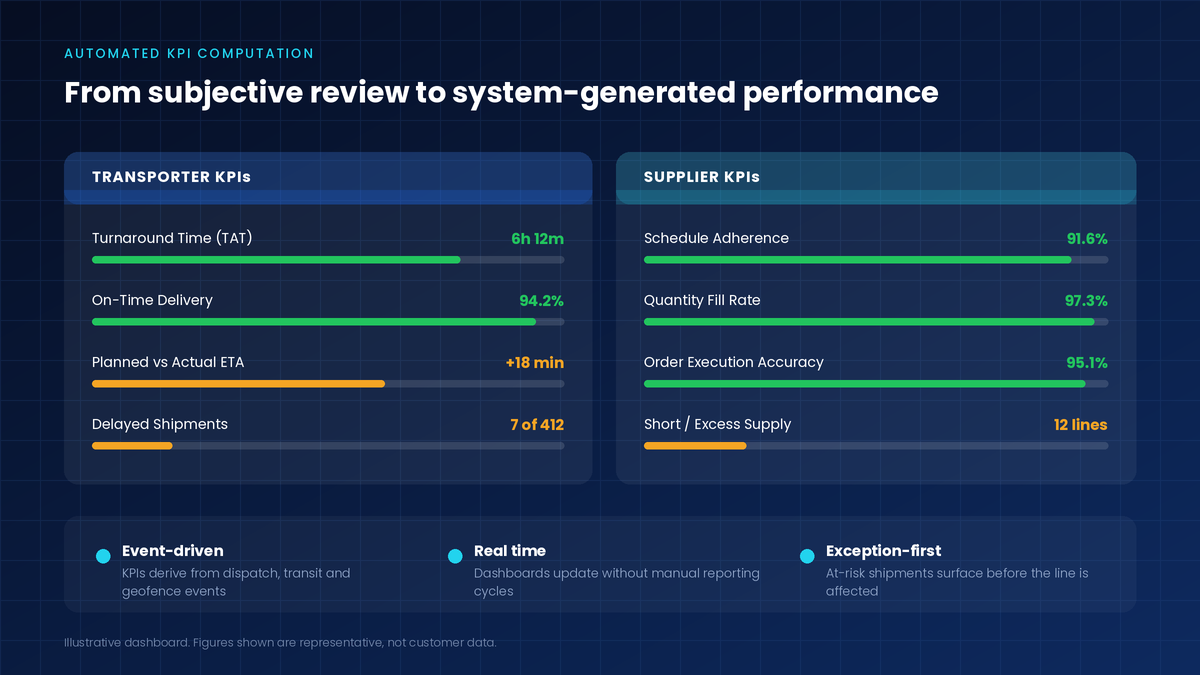
The strategic shift here is bigger than the reporting savings: the OEM moved from subjective assessment to objective, real-time performance management across the entire supplier and transporter base. Vendor reviews stopped being debates.
Business benefits delivered
- Improved visibility across the inbound supply chain
- Reduced dependency on manual coordination between planners, suppliers and transporters
- Early identification of delays and risks, while there's still time to act
- Better manufacturing line planning, based on actual material movement rather than assumptions
- Increased accountability of suppliers and transporters, backed by system-generated evidence
- Faster, better-informed decisions at every level
In short: a supply chain that moved from reactive firefighting to controlled, proactive management.
Key takeaway
A connected supply chain is no longer optional in automotive manufacturing. The volumes are rising, the variant complexity is rising, the buffers are gone, and the cost of a stopped line has never been higher.
By implementing a Digital Supply Chain Control Tower on LogixPlatform, an OEM brings suppliers, transporters and internal teams onto a single platform — enabling real-time visibility, tighter coordination and measurable operational efficiency. Not as a technology project, but as a production-protection measure.
How LogixGRID supports the automotive industry
LogixPlatform manages automotive logistics operations for leading two-wheeler, passenger vehicle, commercial vehicle and construction equipment manufacturers — across inbound supplier flows, in-transit visibility and plant-level material tracking.
We help automotive enterprises implement Control Tower solutions that connect OEM systems, supplier networks and logistics partners on one platform: real-time visibility, mobile-based tracking and automated performance monitoring, built on an integration layer designed for the API/EDI reality of automotive supply chains.
Explore the underlying modules: Logix TMS, Logix WMS, Logix Shipping API and our manufacturing logistics solutions.
See what a Control Tower would look like on your inbound flows
Bring us one plant, one supplier cluster and one transporter. We'll show you the visibility gap in your own data — not a generic demo.
Talk To Logistics ExpertsFrequently asked questions
What is an automotive logistics management system?
An automotive logistics management system is software that plans, executes and monitors the movement of materials across an automotive supply chain — from supplier dispatch through in-transit tracking to plant gate arrival. Unlike generic transport software, it is built around production schedules, part-level traceability and supplier performance measurement.
How is a supply chain control tower different from a TMS?
A TMS executes transportation. A control tower sits above execution systems and integrates ERP, supplier systems and multiple logistics providers into one view — correlating what was planned against what is actually happening, and computing performance KPIs across all parties.
Do suppliers need their own software to participate?
No. Suppliers with existing systems integrate via API or EDI. Those without use the supplier interface directly, which keeps smaller Tier-2 and Tier-3 vendors inside the same visibility loop.
How does geofencing improve inbound logistics?
A geofence around the plant automatically records arrival the moment a vehicle enters, removing manual gate entry. Because turnaround time and on-time delivery both depend on that timestamp, automating it makes every downstream KPI accurate and undisputed.
Can this be deployed by a 3PL rather than the OEM?
Yes. 3PLs managing automotive accounts deploy the same control tower to give their OEM clients visibility — which is increasingly how automotive logistics contracts are won and retained.
How large is the automotive logistics market in India?
India's automotive logistics market generated approximately USD 6.97 billion in 2024 and is projected to reach USD 12.01 billion by 2030 — a compound annual growth rate of about 9.5%.
Sources
- Grand View Research — India Automotive Logistics Market Outlook
- Business Standard / ACMA — Auto component industry turnover FY2025–26
- SIAM via Outlook Business — Record vehicle wholesales FY2025–26
- Mordor Intelligence — India 3PL Market
- Manufacturing.net — The $22,000-per-minute manufacturing problem