

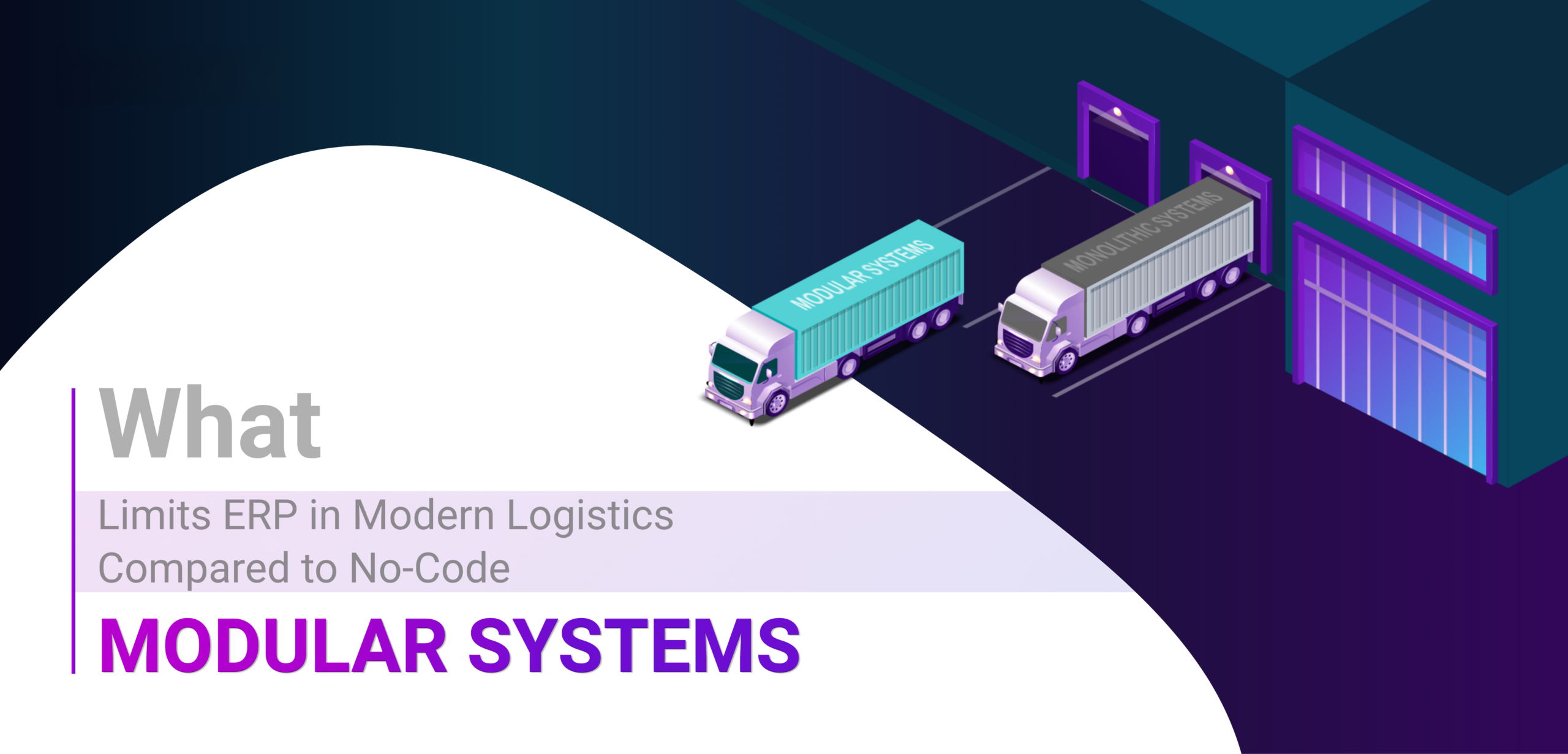
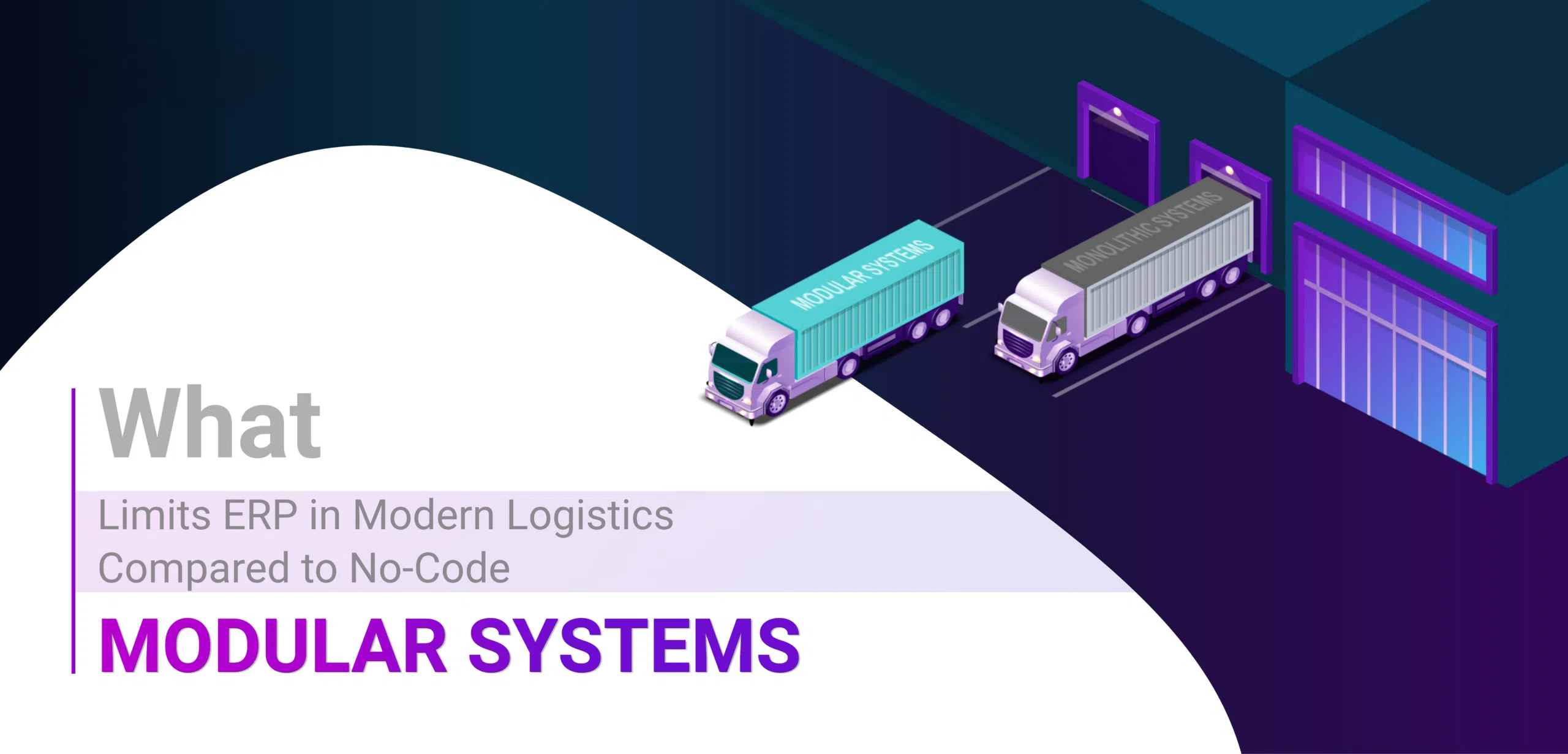
Modular Logistics vs SAP: Why No-Code is Replacing Legacy ERP in Supply Chain Execution
In global logistics, speed is a result and execution is what determines it. In modern supply chain execution, systems designed to centralize and control operations are now being tested by conditions that demand constant change, rapid response and real-time decision-making. The traditional “big suite” model, led for decades by platforms like SAP ERP, is no longer holding up under modern logistics demands. What was built to impose control is now slowing operations at the exact points where speed determines outcomes.
SAP ERP established itself as the core system for enterprise operations by bringing finance, human resources, and supply chain processes into a single, unified platform. That promise of a “single source of truth” was aligned with a business structure that prioritized stability and standardization. Logistics today operates differently. Workflows shift frequently, exceptions are constant and operational decisions cannot wait for system-level coordination. In this context, tightly connected systems begin to introduce friction rather than remove it, especially when compared to modular logistics systems designed for flexibility. This is where no-code modular systems are starting to replace traditional ERP-driven models.
What are the limitations of SAP for high-volume logistics execution?
The issue is structural rigidity. In SAP, even minor changes are forced through multiple layers, turning simple operational adjustments into system-wide exercises that slow execution by design.
As a result, three operational constraints consistently emerge: long deployment cycles, high training overhead and slow customization.
The first is deployment time. Implementations are not measured in weeks or even months, but often in years. Because deployments are tightly coordinated, configuration and testing often extend across multiple system layers before rollout. By the time the system is fully rolled out, parts of it are already misaligned with how the business actually operates.
The second is usability. The interface is dense, and operating it effectively often requires certified training. This creates dependency on a limited talent pool and increases operational friction.
The third is customization. Making even simple changes involves ABAP programming, external consultants, and extended development timelines. Instead of enabling quick operational adjustments, every change is pushed through development cycles that delay execution and disconnect systems from real-time operations. This creates a lag between identifying an issue in operations and implementing a fix within the system.
These limitations show up clearly in day-to-day operations.
| In real operations | In SAP | In Modular Systems (LogixFlow) |
|---|---|---|
| Change required in routing rule for a specific client | Raised as a request, passed to developers, validated across dependent workflows before implementation | Updated directly within the workflow without affecting unrelated operations |
| A process breaks during live operations | Issue is identified, escalated, and manually resolved after analysis | System detects the condition and triggers predefined actions automatically |
| Issue identified with predefined corrective action | Still waiting for development cycles and approvals before action | Fix is implemented immediately at the workflow level |
| A new client requires a different operational flow | Requires system-level configuration and alignment across modules | Add or adjust a module and configure logic specific to that client |
| Shipment volume spikes unexpectedly | Increased coordination required, changes become slower to implement | Workflows continue independently without added system dependency |
| Ops team wants direct control over execution | Dependent on technical teams and system constraints | Controlled directly by operations through no-code interface |
The difference becomes clearer when you look at how execution flows through the system.

What is a modular logistics engine and how does it work in modern operations?
As logistics operations become more dynamic, the need for systems that can evolve without systemic disruption has increased. Modular systems address this by decoupling operations into independent components that can be deployed and modified without affecting the entire system.
Platforms like LogixGrid’s, LogixPlatform and LogixFlow represent this approach. Instead of a single, unified system, they provide a library of over 200 specialized modules built for distinct logistics use cases such as express operations, cross-border workflows, courier management, reverse logistics, and 3PL billing. These modules can be combined based on operational requirements, allowing businesses to construct systems that align with how they function in practice.
LogixFlow builds on this approach with a no-code interface where operations teams design workflows directly. Changes no longer depend on development cycles. Instead, they can be configured directly within the system using visual logic, reducing turnaround time and removing dependency on technical intermediaries. The result is a system where execution logic can evolve in parallel with operations.
Why does no-code enable faster execution compared to ABAP in logistics systems?
The difference between ABAP-driven customization and no-code configuration is not just technical. It directly impacts execution speed. In SAP operations, customization is gated by development pipelines, which means execution is always delayed by design. In a no-code system, workflow adjustments can be implemented as soon as the requirement is identified.
This shift compresses the time between decision and execution. A logistics manager can configure routing logic, exception handling rules or process variations without waiting for backend changes. The system stops delaying execution and starts acting at the speed of operations instead of holding it back.
Why do specialized logistics modules perform better than generic ERP features?
ERP systems are built for broad enterprise coverage, which results in generalized features that don’t match how logistics actually operates. In logistics, this creates a mismatch between system capability and operational specificity. Processes such as air freight handling or 3PL billing require detailed, domain-specific logic that generic systems are not optimized for.
Modular platforms address this by offering pre-built components structured for logistics scenarios. LogixPlatform’s modules are designed for specific operational contexts, allowing businesses to implement functionality that directly reflects their workflows. This removes the need for constant workarounds and allows the system to align directly with operational reality instead of forcing adjustments.
How does AI improve execution control in logistics systems compared to traditional ERP analytics?
The third is control and monitoring. While SAP provides data and reporting, the responsibility for interpretation and action remains largely manual. LogixFlow introduces AI-driven capabilities that move beyond passive analytics. The system can identify disruptions, suggest corrective actions such as rerouting, and trigger alerts based on business rules. This reduces the gap between detection and response, where traditional systems rely on manual intervention after visibility. The system moves from passive visibility to direct intervention, removing the delay between identifying a problem and acting on it.
Why does modular deployment reduce cost and risk in logistics systems?
The fourth is deployment and cost structure. Traditional ERP implementations often require large-scale, end-to-end rollouts. This “all or nothing” approach increases both risk and investment. Modular systems allow for incremental adoption. A company can deploy specific components, such as warehousing or cross-border management, without replacing the entire system. Implementation effort is limited to targeted areas instead of requiring enterprise-wide coordination. This reduces disruption to ongoing operations during system rollout.
How do modular logistics systems handle high-volume logistics operations more effectively than ERP?
The fifth is scalability. One of the primary concerns when moving away from established ERP systems is the ability to handle high data volumes. LogixFlow addresses this by maintaining the processing capabilities required for large-scale logistics operations while retaining flexibility at the workflow level. Scaling does not introduce additional system rigidity or require restructuring workflows. Operational processes can continue adapting even as transaction volumes increase.
What actually happens when logistics volume increases?
As logistics volume increases, systems are expected to process more transactions without degrading performance. However, volume also introduces variability, requiring more frequent adjustments across workflows.
In SAP-based environments, increased volume amplifies system interdependencies. Changes become harder to isolate, and the effort required to implement them rises. The system becomes more stable, but less adaptable.
In modular systems, volume does not introduce the same level of constraint. Workflows operate independently, allowing adjustments to be made without affecting unrelated processes. This maintains execution speed even as operational complexity increases.
Why are modular, no-code systems replacing traditional ERP?
The shift away from rigid ERP systems is not a matter of preference. It is already happening at the operational level. Logistics execution no longer waits for systems to catch up. They move, and systems either support that movement or slow it down.
Platforms like SAP were built to enforce structure. In modern logistics, that structure now slows response where speed matters most. In conditions where workflows change daily, a system that requires coordination, development cycles, and external dependency for every adjustment becomes a limitation.
Modular, no-code systems are a structural correction, not an upgrade. They remove the dependency between change and complexity, allowing operations to respond without friction.
At this point, the trade-off is already visible in how teams operate. Some are still waiting on systems to catch up. Others have moved to systems that keep up with them.
Key Takeaways
- Execution delays in SAP come from routing changes through multiple system layers
- Modular systems keep execution within workflows, reducing dependency on development cycles
- No-code allows ops teams to adjust routing, billing, and exception handling directly
- Performance breaks under variability, not just volume
FAQ’s
Yes. SAP handles financials, while modular systems manage routing, workflows, and execution.
Routing rules and process logic can be updated directly without development cycles.
Each client’s workflow is configured independently, without affecting other operations.
Workflows can be updated directly without relying on development teams.
When operations involve frequent routing changes, exceptions, or client-specific workflows.